

Inspiration > Design Trends > Soul: Your Space in the Silence

Soul: Your Space in the Silence

26 September 2026

Why the quietest corner of an office may be the most productive one — and what goes
into building it.

The office opened up. Then it got loud.

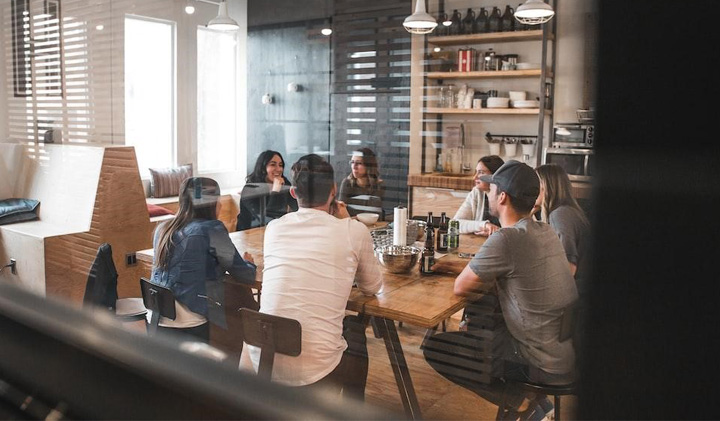
For more than a decade, the open plan was the default answer to almost every workplace brief. Take down the cabins, pull out the partitions, seat everyone together, and collaboration will follow.

It has not quite worked out that way. When researchers at Harvard tracked two Fortune 500 headquarters moving from cubicles to open floors, face-to-face interaction fell by roughly 70 per cent. Email and instant messaging rose to fill the gap. People sitting ten feet apart began typing to each other.

The instincts of the users.

The instinct behind that is easy to recognise. In a room where everyone can hear you, a phone call becomes a performance, a difficult conversation becomes public, and a train of thought becomes everyone else’s to interrupt. So people withdraw — headphones on, eyes down, or out to the stairwell for the call they would rather not broadcast.

The problem was never openness. The problem is that openness was delivered without its other half: somewhere to go when you need to concentrate, to speak privately, or simply to hear yourself think.

We have always known where to find ourselves

Every tradition that has taken the inner life seriously prescribes the same condition, and it is not a technique or a posture. It is silence. Meditation, prayer, the ten-day retreat, the walk taken alone before the house wakes up — each of them begins by removing other people’s noise.

Nobody discovers themselves in a crowd.

The science agrees, in its own vocabulary. Attention is a finite resource, and of all the sounds that drain it, intelligible human speech is the most expensive. You cannot ignore a conversation you are able to follow; the brain processes the words whether you want it to or not. That is why a colleague’s phone call is far harder to work through than an air-conditioner humming at exactly the same volume.

So when it came to naming this product, one word kept returning. Soul. Your space in the silence.

What silence is actually made of

Silence is engineered, not decorated. Soul manages sound in four layers, each doing a different job:
  • Sound proofing. The outer skin turns noise away before it reaches you.
  • Sound absorption. Inner acoustic surfaces soak up voice and echo, so your own words do not bounce back at you.
  • Sound reduction. Damping material in between breaks the path sound would otherwise travel through the panel.
  • Airtight construction. Sound behaves like water. A gap is a leak, and the finest acoustic panel is undone by a door that does not seal.
Together they deliver a tested reduction of around 30 dB. In everyday terms, that is the difference between following every word of the conversation outside and hearing a distant murmur you can easily ignore.

A space that knows you have arrived

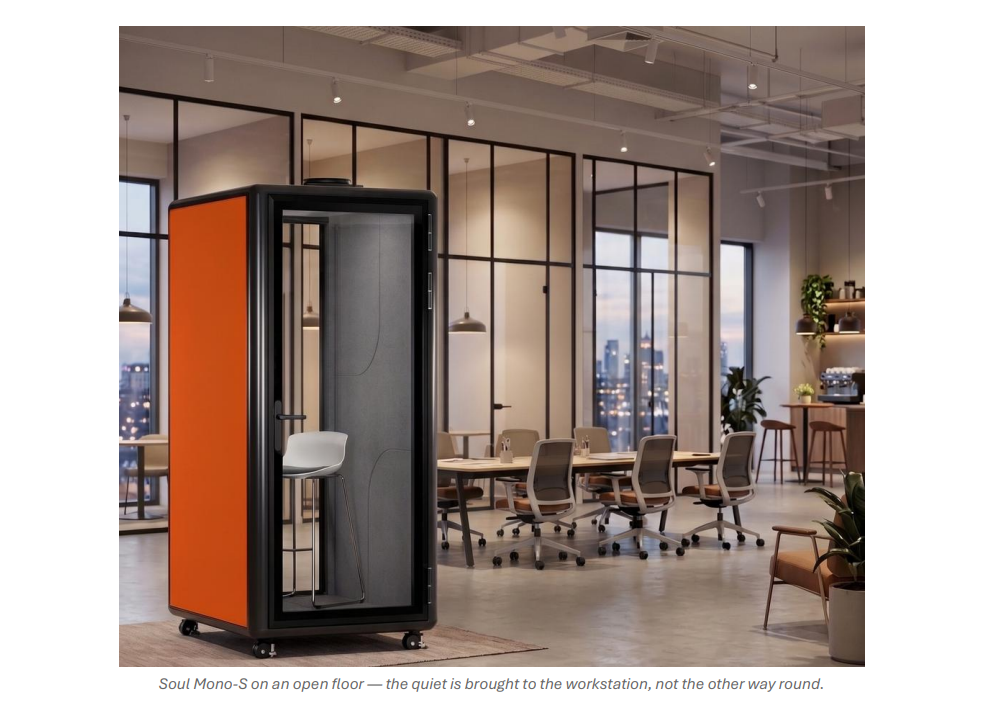
Step in, and Soul responds. Motion sensors bring up the lighting and ventilation the moment you enter, and power them down when you leave — no switch to hunt for, and no energy spent on an empty pod. Air is circulated quietly and continuously, so a ninety-minute call is as comfortable as a five-minute one. Ergonomic furniture is already inside, so the booth is usable from the day it lands.

These sound like small things. They decide whether people use the booth or walk past it.

What it means for the people who specify it

For architects, designers, PMCs and facility teams, the practical case is as strong as the human one:
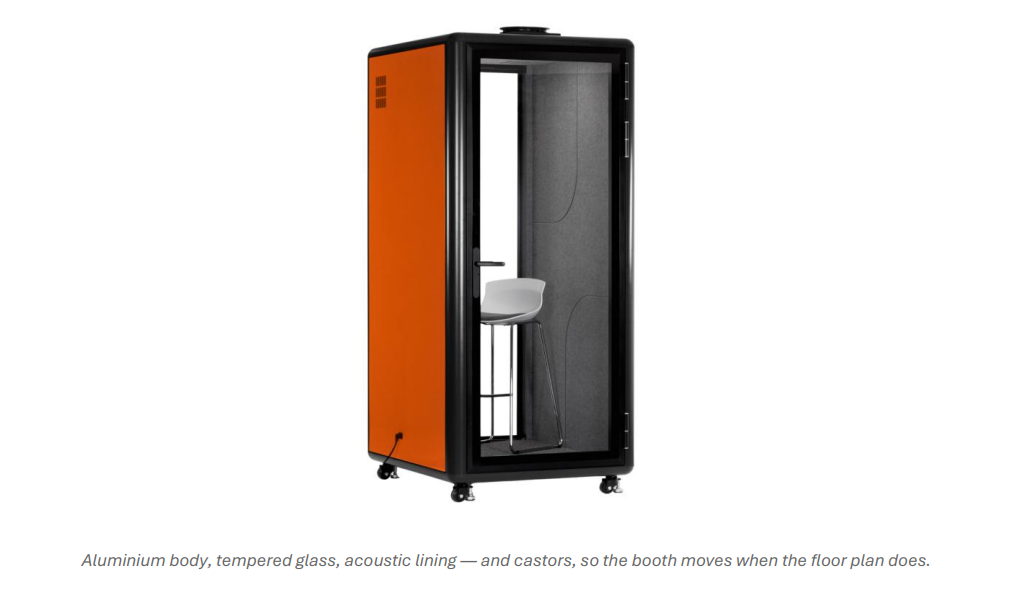
  • Lightweight aluminium and tempered glass. Strong and durable, considerably lighter than a steel-bodied booth, and recyclable at end of life.
  • Plug and play. A standard electrical outlet is all it needs — no special wiring, no civil work, no long lead time on site.
  • Relocatable. Castors and a light structure mean it moves with team churn instead of being demolished and rebuilt.
  • Entirely modular. Outer panels, acoustic panels and power modules can each be replaced, so the booth stays serviceable across a full fit-out life.
  • Customisable. Outer and acoustic panels come in a choice of finishes, so it reads as part of the interior rather than an object parked in it.
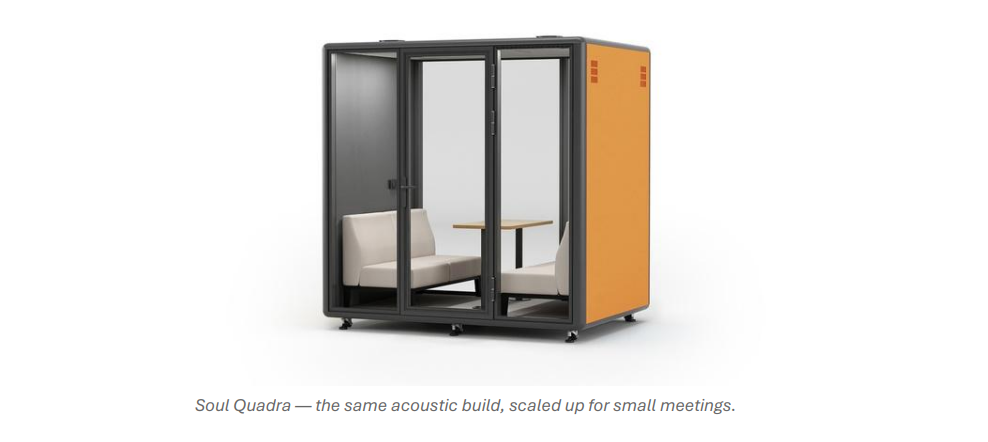
  • Four sizes, one language. Mono-S (1000 x 1200), Mono-T (1520 x 1200), Quadra (2200 x 1600) and Hexo (2200 x 2200), all 2200 mm high — from a single caller to a six-person huddle.

The quiet part

Most offices do not need more space. They need a quieter one.A booth like this is not a break from work. It is very often where the work happens — the decision that has been postponed, the idea that has stayed half-formed for weeks, the sentence you finally know how to say because nothing interrupted you while you found it.

That version of you has not gone anywhere. It just needs somewhere quiet enough to be heard.

Soul. Your space in the silence.

Explore more design trends

Smart Office Furniture Solutions: The Future of Work Starts with Smarter Spaces – Part 1 Technology Lockers

24 July 2025

The Secrets To Productive Workplaces

7 January 2022

5 Trends That Will Define The 2024 Workplace Design

7 January 2022

Contact Us Download Virtual Configurator
Select the fields to be shown. Others will be hidden. Drag and drop to rearrange the order.
  • Image
  • SKU
  • Rating
  • Price
  • Stock
  • Availability
  • Add to cart
  • Description
  • Content
  • Weight
  • Dimensions
  • Additional information
Click outside to hide the comparison bar
Compare